# Hardcover: 304 pages
# Publisher: Bloomsbury USA, 2006
# Price: $24.95
# ISBN: 1596911425
Surrounded by forces in blue, and most every other color of uniform, Rainbow Farm blazed in a fury of flames while guns were trained on the two owners as they emerged: first, Tom Crosslin, 46, then his much younger lover, Rolland "Rollie" Rohm, 28. Crosslin was shot through the forehead by a FBI sharpshooter. Rohm emerged into the open field 12 hours later and, after setting fire to the farmhouse where he had lived with Crosslin since the early 90s, was hit by the bullet of a Michigan State Police sharpshooter. The bullet first split the butt of Rohm's rifle before entering his chest, splattering him with blood but leaving him on the ground still alive. Or so some say. After that, questions arise, still unanswered.
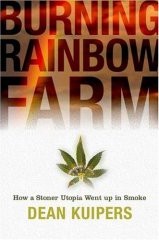
"The most intriguing stories take place under our very noses," says Dean Kuipers, author of Burning Rainbow Farm: How a Stone Utopia Went Up in Smoke, when I spoke to him recently during his book tour, making a stop in Kalamazoo. Kuipers, deputy editor at LA City Beat in Los Angeles, California, but with deep roots in southwest Michigan, couldn't let go of the story since he first read about it in the Kalamazoo Gazette in September 2001. He is a well-trained journalist; good stories eat away at him until transformed into print.
"The news tends to focus on the crime and the alleged criminals," Kuipers says. "But a crime story involves an entire community. The Rainbow Farm story involved everyone: the gay and straight communities, the evangelical and the atheist, every spectrum of politics. Every community is a mixed bag, and I wanted to dig into the community in and around Rainbow Farm, go deeper than the media had, and explode it out like a flower."
Kuipers took four years to explode out this flower of every imaginable type and perspective on what some referred to as "our own little Waco." He returned to his home grounds and conducted several hundred interviews in and around Cass County, specifically Vandalia, Michigan, where the farm was located, and around Elkhart, Indiana, 30 miles south, from where Crosslin and Rohm had come.
"People were very reticent to talk to me," Kuipers says. "I had to work hard for this, knock on a lot of doors."
Eventually, trust in the reporter from Los Angeles grew and Kuipers started to piece together the story of "a hippie campground famous for peace, love and weed." As the story took shape, Kuipers wrote an article in 2003 that appeared in Playboy Magazine. He wrote: "On the day that he purchased Rainbow Farm, Tom Crosslin said destiny had led him to the place. By the late 1990s the farm would become a well-known stop on the hippie trail, a scenic overlook for the migratory flocks of travelers and Phish fans who crisscrossed the country. For thousands of blue-collar pilgrims who stopped there looking for a few days of fun and freedom in Michigan's vacation lands, it was a benevolent little campground. And on any other Labor Day they would have been there: thousands of happy stoners setting up tents for Crosslin's annual marijuana-legalization fest, a party he'd named Roach Roast."
Crosslin, Kuipers writes, "came from a world of muscle cars, factory work, girls and getting stoned." He'd quit school around 10th grade and had been working ever since — at a little bit of everything. He was a factory worker and a truck driver, he managed a car wash, worked in construction, started his own string of businesses, and purchased property as investments. He married, then divorced, coming to the realization that he was gay. He loved a good, raucous party, and he was known for his cookouts, well lubricated with cases of beer, serving vegetables he grew in his garden. Fun-loving and easygoing, Crosslin was known to be rather promiscuous… until he met Rollie Rohm. The two fast became something of an odd couple. While Crosslin was then 34, Rollie was all of 16 years old, a school dropout too, sporting a first moustache to match his long blonde hair. In spite of his youth, he had already fathered a son, Robert, married briefly, more out of a sense of responsibility than love. Rollie had grown up being bounced from foster home to foster home, and it was undeniable that Tom Crosslin was something of a father figure to him, taking him under his protective wing. They became inseparable.
Eventually, the two moved from Elkhart, Indiana, to Vandalia, Michigan, because Crosslin had found what seemed like his and Rollie's utopia — a farm that could be home to both of them and the little boy, Robert, as well as a place where all would be welcome. The party that would never have to end. A beer-swilling and pot-smoking good ol' boy, Crosslin saw this farm in the country as a place where they could gather with friends in peace while getting on a buzz, harmless fun, and keep it all legal because he had firm rules about no selling, no dealing, no hard drugs. The mission statement of Rainbow Farm, according to the Web site for the campground, reads: "Rainbow Farm supports the medical, spiritual, and responsible recreational uses of marijuana for a more sane and compassionate America. They also encourage the vast agricultural and industrial uses of the natural substance cannabis hemp as an environmentally safe alternative to thousands of synthetic products now being mass consumed in this country at a tremendous cost to our environment. Above all, [Rainbow Farm] supports freedom in America."
The two were well liked, for the most part, in their rural community. Crosslin was always ready to share his wealth, accumulated mostly from his real estate investments. He purchased toys for area children for Christmas when they had none. He invested in lunch programs in the area schools so that no one would ever go hungry when attending school. It was hard not to befriend him, although he did occasionally lose his temper in a bar brawl, having one too many.
The festivals the two men threw on the farm were for fun, sure, but they also had political purpose. It was this, no doubt, that most drew the ire of law enforcement. Crosslin set up booths during his fests that passed out brochures urging the decriminalization of marijuana use. Those manning the booths gathered signatures on petitions to get an amendment on the Michigan ballot.
Complaints about the festivals were mostly about noise and litter, not about drug use. Rainbow Farm had its own security system patrolling the grounds, including the Michigan militia, although without use of weapons, relying only on presence and the ever-watchful eye. Crosslin would not give in to use of hard drugs because he understood that this was crossing the line, not something of interest to him personally, and would endanger his property.
The Cass County prosecutor, Scott Teter, known to be a conservative Republican, (interestingly enough, Crosslin and Rohm shared this political party affiliation with Teter), was not amused. Teter was known to be law enforcement strictly by the book, and Rainbow Farm was all about testing the limits. More than one area resident referred to the tension between the two forces — the county prosecutor and Rainbow Farm — as the head-butting of the Dukes of Hazzard and Boss Hogg. It would only get worse.
Kuipers writes about the escalating tension between Rainbow Farm and law enforcement, specifically Teter, with a journalist's professionalism. He states the facts, quotes the witnesses, interviews all who are willing. He cites the war of lawsuits and filed complaints, contained to paper until it no longer was. Teter eventually filed documents threatening forfeiture of property if Crosslin and Rohm would not back down on their annual festivals, gathering many hundreds under the sweet stink of marijuana clouds. At one point, the young boy, Robert, Rohm's son, by then 12 years old, was taken from school into custody and placed with a foster family. It was surely, if not the last straw, one of the very last. Court orders were filed forbidding festivals on the farm property, and others that paved the way for seizing the property as a public nuisance. Charges were made after searches on the property turned up potted marijuana growing in the farmhouse basement and firearms were found in the house. Crosslin and Rohm were charged with a felony, and events were fast coming to a head.
Crosslin was defiant, he had made the war on drugs his own, and he was going down fighting. As law enforcement tightened their circle around the farm, he and Rohm drew up wills, passed out belongings, and loaded their guns. The day they were to show up in court to face the charges, they instead set fire to the farm. News helicopters circled overhead, smelling a messy story, and the FBI and state police were called in as reinforcements.
As the final day dawned, 120 law enforcement officers surrounded the farm. Friends tried to convince Crosslin and Rohm to surrender — themselves and the farm — even as the smoke rose from the various buildings, but Crosslin stood firm. He was in this for the long haul. When coffee ran out, he headed towards a neighbor's farmhouse on a path out back, brought the coffee back, then, deciding he needed the coffeepot, too, he headed back. It was on this second return trip that the FBI shot Crosslin; stories conflict on who shouldered their weapon first.
Rohm was alone at the house, and what exactly happened next varies even more than the stories woven around Crosslin's death. A miscommunication? Too quick a draw? Rohm had agreed over the phone to surrender after dawn. Just before he emerged, the farmhouse began to burn, smoke and flames rising, and Rohm came out carrying a firearm. Reports say he appeared frightened and confused. He wasn't used to making decisions without his partner. Running from the house, he seemed to stop in confusion, changed direction to run back to the house again. A state police vehicle appeared, and someone said Rohm shouldered his weapon, ready to fire, but never did. Instead, a bullet from a state trooper's firearm brought him down. He was handcuffed, still alive, maybe.
Kuipers writes: "The official version of events — that Crosslin and Rohm both raised their rifles — was soon disputed. Within days, investigations were launched by the families, the prosecutor, the state's attorney general, the state police, the FBI, even the Michigan militia. The lawyer handling a wrongful-death suit for Rohm's estate says the state police account of Rohm's death is seriously flawed… the police case is forensically baseless."
Adding fuel to the Rainbow Farm fire is a finding later in an autopsy done on Rollie Rohm. His testicles were missing, recently, it seemed, cut off. Why? By whom? For what purpose? The wrongful-death case is still pending, and readers of Dean Kuipers's book, Burning Rainbow Farm, will find themselves intrigued, perhaps even rethinking the war on drugs and how far we are willing to take it.
Kuipers says his purpose in writing the book was not out of wanting to push a political agenda — he doesn't smoke marijuana himself — as much as to show "that your neighbors are all right. This is a book about neighbors. About tolerance in a community. And how intolerance that often comes from outside the community can bring it to ruin."


