Tuesday, December 05, 2006

The Second Half of Life by Angeles Arrien

Book Review by Zinta Aistars


  • Hardcover: 208 pages
  • Publisher: Sounds True (April 2005)
  • Price: $21.95
  • ISBN: 1591792525


There is nothing new in Angeles Arrien's book about the second half of life. Indeed, there isn't meant to be. Our lives at midpoint are about putting aside newness and embracing the ancient, the everlasting, the always true.

We live in an age that worships youth. Alongside this naive, if not indeed tragic pursuit to resist aging in all its aspects, we find ourselves as a society becoming ever more superficial, ever more devoted to what is external only, short on endurance, shallow in meaning. Small wonder so many of us approach midlife in a state of "crisis."

Yet there is no crisis. Arrien reminds us, by assembling in this collection of eight chapters named for eight gates, that this is not a time in our lives to resist or fear, but that it is, in fact, a time of wonder and beauty -- of the deeper and more meaningful kind. To pass through each of these "gates" is to be opened and enriched by the enlightenment of the second half of our lives. In each chapter, Arrien has brought together age-old quotes and wisdom from many different cultures, tested by time and place. Each chapter describes the gate through which we must pass, the task we must undertake to do so, the challenge, the gift we receive if we meet the challenge, reflections that help us to understand more fully this threshold, a list of practices to make this gateway a discipline.

The gates: silver (facing the new and the unknown); white picket (discovering one's true face); clay (intimacy, sensuality, sexuality); black and white (relationships and the crucible of love); rustic (creativity and service); bone (authenticity, character, and wisdom); natural (happiness, satisfaction, and peace); gold (letting go).

Each chapter guides us, gently yet firmly, toward facing what is around us as well as what is in us. The overall effect is soothing, I find, to the degree that it has helped me, approaching my own midpoint in life, see the aging process for the beauty and freedom it brings. It is a time to free oneself of the cumbersome masks one has worn in a more naive youth, to embrace wisdom and meaning rather than that which passes quickly and leaving no lasting mark. It is a time to gather all that we have learned in the first half of our lives and bring it all to fruition, entering a time of unbounded creativity, love based on truth rather than illusion, and finding a peace that will make crossing that final gold gate a time of celebration for a life well lived.

If we have lost respect for aging in our society, it is time we take it back. Arrien reminds us, by bringing back the wisdom of the ages, that age in ourselves is something to be welcomed rather than resisted. To resist it is to rob ourselves of what may well be the best time of our lives.

Tuesday, October 10, 2006

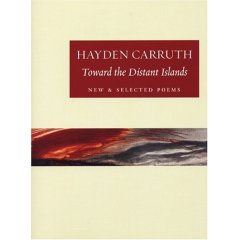
Toward the Distant Islands by Hayden Carruth

Book Review by Zinta Aistars


# Paperback: 150 pages
# Publisher: Copper Canyon Press, 2006
# Price: $17.00
# ISBN: 1556592361


Over many years of reading poetry, I've come to trust that any poetry book published by Copper Canyon Press is going to be an adventure. This collection, hand-picked by Press founder, Sam Hill, is no exception. I'd read enough of Hayden Carruth's work that I expected to be impressed, and I was.

The poems are selected from 12 previous collections (oh, if all of us poets could boast of so many published books!) with an addition of new poems at finish to keep the appetite whetted for more yet to come. It is interesting to watch for change and growth in the whole of Carruth's work, but that his talent was richly showing early on - the first batch selected dates back to 1959's The Crow and the Heart - is clear:

Of all disquiets sorrow is most serene.
Its interval of soft humility
Are lenient; they intrude on our obscene
Debasements and our fury like a plea
For wisdom...

Sorrow can shape us better than dismay.


Carruth understands the peaks and valleys of a man's life. As Sam Hill notes in his introduction, this is a poet who has struggled with angels and demons alike, finding both in himself. So his work reflects such struggles, and we swing upwards with him to whisper with angels, just as we slide into shadows with him, to weep and gnash teeth with dark demons. If a poet creates often from the grit inside him, as an oyster its pearl, then this poet proves the old axiom. We must know the demon to recognize the angel; we must strive to be angelic to fully understand the power of the demonic.

Carruth writes glorious love poems to his wife, filled with appetite and relish and adoration. He writes love poems to his daughter, lost too early to cancer. He writes love poems to the natural world around him, and to the characters that are found in humanity. He writes love poems to sorrow.

This is a poet who lives his life seam to seam, depth to height, and journals it into his lyric work. To share in his journey, this is a collection not to be missed.

Tuesday, September 26, 2006

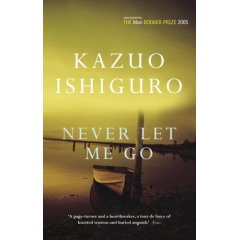
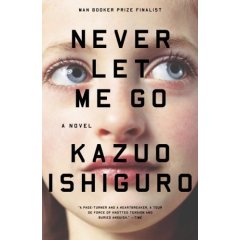
Never Let Me Go by Kazuo Ishiguro

Book Review by Zinta Aistars


# Paperback: 304 pages
# Publisher: Vintage, 2006
# Price: $14.00
# ISBN: 1400078776


Never really had me to let go of me... nevertheless, Kazuo Ishiguro's Never Let Me Go was an intriguing read, reeling me in ever so gradually, nearly losing me, never fully snagging me, but throwing me bait of disconcerting revelation just frequently enough to keep me turning pages. By end, I had to admit I had enjoyed reading the book more than, well, than I had realized while reading it.

Which is the kind of odd quality, odd hold, this novel has over the reader. Ishiguro writes in unassuming language. His story seems quite ordinary, initially nothing much more than a coming of age tale, and it runs over 80 pages before I got my first real jolt. Even that, more of a tug than a jolt. The reader begins to notice something strange going on, little weirdnesses tucked between the everyday routines. Once the reader realizes the scene unfolding is not quite as ordinary as first thought, interest grows.


This is a dark tale of human beings being treated as less than human beings, of human clones grown and nurtured for the sole purpose of harvesting their organs, and their less than humane treatment, even though in appearances humane, based on various societal biases or perhaps only less than clear thinking, or faulty value systems. Indeed, this is Ishiguro's mastery. He has given something very dark, some might say evil, a face so bland it goes almost unnoticed. And, isn't this how evil pervades society every day? Monsters are rarely big and green and warty. Strangers are often your favorite uncle, or the boy next door. The taking down of civilization is not done with a big bang, but with nibbles and bites, a gradual desensitization. Ishiguro's evil is seemingly meek and submissive, as if done for the wellbeing of the masses, and that may arguably be the tactic used most successfully. In novels as well as in life.